
DEMO MODE · OFFICIAL HACKATHON SAMPLE DATA
DataHub Agent Hackathon 2026
Rosetta mascot

One metric. Two meanings.
Silent chaos.

A linter for meaning across your DataHub graph.

Rosetta detects conflicting metric definitions, traces their downstream impact through DataHub lineage, and prepares a human-approved remediation plan. In Connected Mode, approved plans can be executed and verified through metadata read-back.

Five-agent pipeline 96 automated tests 88.4% conflict confidence 585 assets at risk Approval-gated remediation
GitHub

Public demo: deterministic Demo Mode — no DataHub credentials required.

The Problem

Here's what a semantic conflict looks like.

Two teams define the same metric differently inside DataHub. Nobody notices. Downstream reports silently diverge. Rosetta finds it, measures it, and proposes the fix.

⬡

DataHub-native

Reads URNs, lineage edges, and glossary terms directly from the DataHub metadata graph.

◎

Blast-radius scoring

Traces every downstream dashboard, ML model, and dataset touched by the conflict.

✦

Human-approved fix

The Broker proposes a canonical GlossaryTerm. You approve, and Rosetta generates a validated DataHub write plan.

▶

No LLM, fully deterministic

Conflict detection uses logic-similarity comparison — reproducible and auditable every time.

CRITICAL CONFLICT DETECTED ID: CNFL-892
Metric billing_amount
CLINICAL_TEAM
SUM(base_charge) + SUM(medication)
FINANCE_TEAM
SUM(base_charge) − SUM(discounts)
Downstream impact 1,215 bad rows · $28.48M affected transaction value in sample data ⓘ
✦ Proposed Canonical Definition
SUM(base_charge) + SUM(medication) − SUM(discounts)
What makes Rosetta different

Data quality tools ask whether values are valid. Rosetta asks whether the organization agrees on what those values mean.

Five Agents · One Pipeline

Rosetta runs five specialised agents end-to-end.

🧲
Harvester
🔍
Detector
💥
Blast Radius
🤝
Broker
✅
Writer

Try it — no credentials needed.

Choose a sample dataset below. Rosetta runs locally, so no account or credentials are required.

🏥

Healthcare Network

Hackathon sample data: billing anomalies and clinical/finance definition conflicts across a synthetic healthcare pipeline.

55,500 records 5 conflicts detected
Official hackathon data
🛍️

Fiction Retail Co.

E-commerce orders where marketing and logistics disagree on key metrics.

150,000 orders 2 conflicts detected
Supplementary scenario
Native Integration

Bring your own graph.

Running DataHub in production? Point Rosetta at your GMS endpoint and let it trace lineage automatically — no access to underlying data required.

  • Harvests GlossaryTerm definitions via the Metadata API
  • Traces downstream lineage transitively without touching data
  • Proposes a canonical GlossaryTerm and computes a plan hash
  • Enforces explicit human approval before any write operation
  • Executes only upsert, attach, and deprecate ops
  • Re-reads every changed entity to verify the applied state
Demo Mode
  • Runs on official hackathon sample data
  • Generates and validates the full write plan
  • Approval token issued; SHA-256 plan hash recorded
  • No external catalog is ever modified
  • Result: VALIDATED · NOT EXECUTED
Connected Mode
  • Reads from your DataHub GMS endpoint
  • Approval token must match exact plan hash
  • Approval-gated: executes only after explicit human sign-off
  • Re-reads every changed entity to verify applied state
  • WRITE COMPLETED · VERIFIED only when read-back confirms every operation
$ export DATAHUB_GMS_URL="http://localhost:8080"
$ export DATAHUB_TOKEN="your_token_here"
$ rosetta scan --mode=datahub --full
> Initializing Harvester Agent…
> Connected to DataHub v0.12.1
> Discovered 4,192 datasets
> Building lineage graph…
The Problem & The Fix

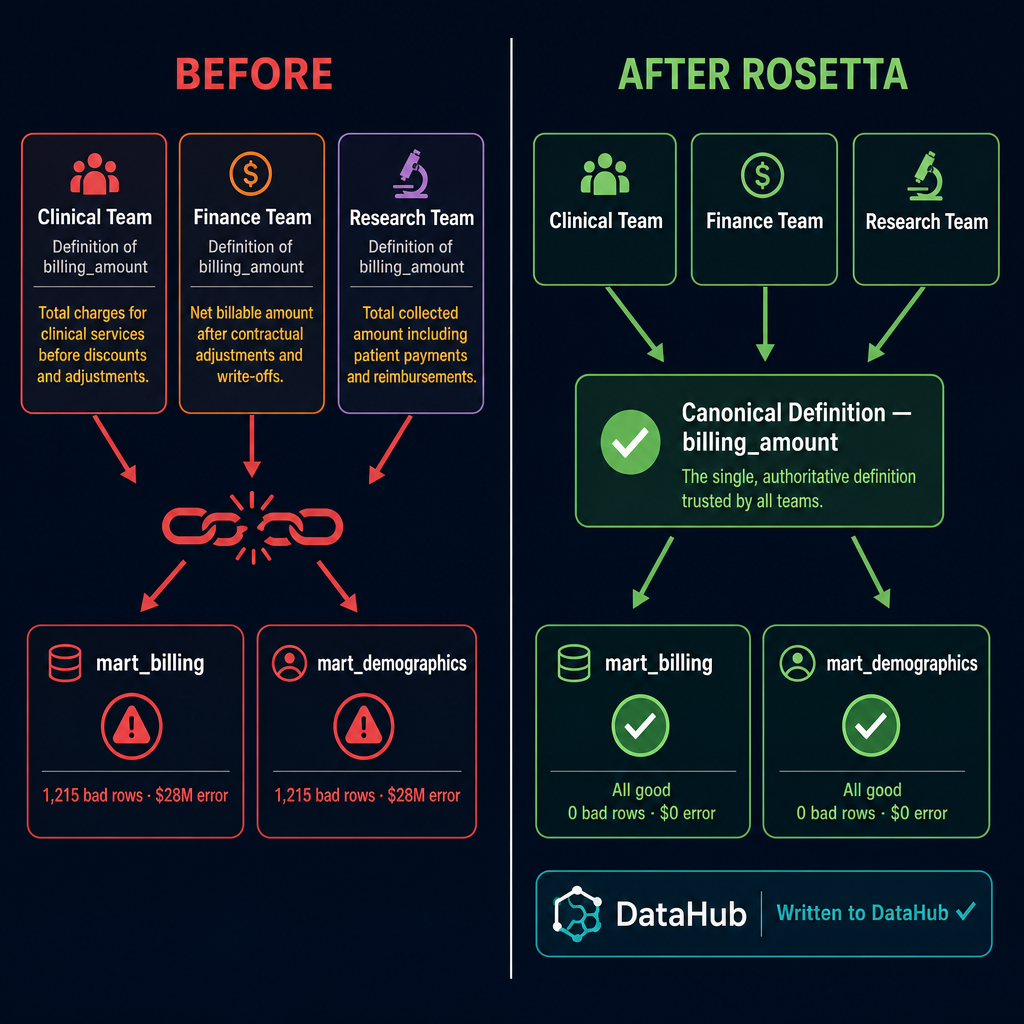
Three teams. Three definitions. One conflict resolved.

Before Rosetta: three teams silently disagree on billing_amount, landing 1,215 bad rows and $28.48M in affected transaction value in the sample dataset. After: one canonical GlossaryTerm proposed for DataHub, all downstream assets identified for alignment.

Before and after Rosetta resolves the billing_amount conflict
How It Works

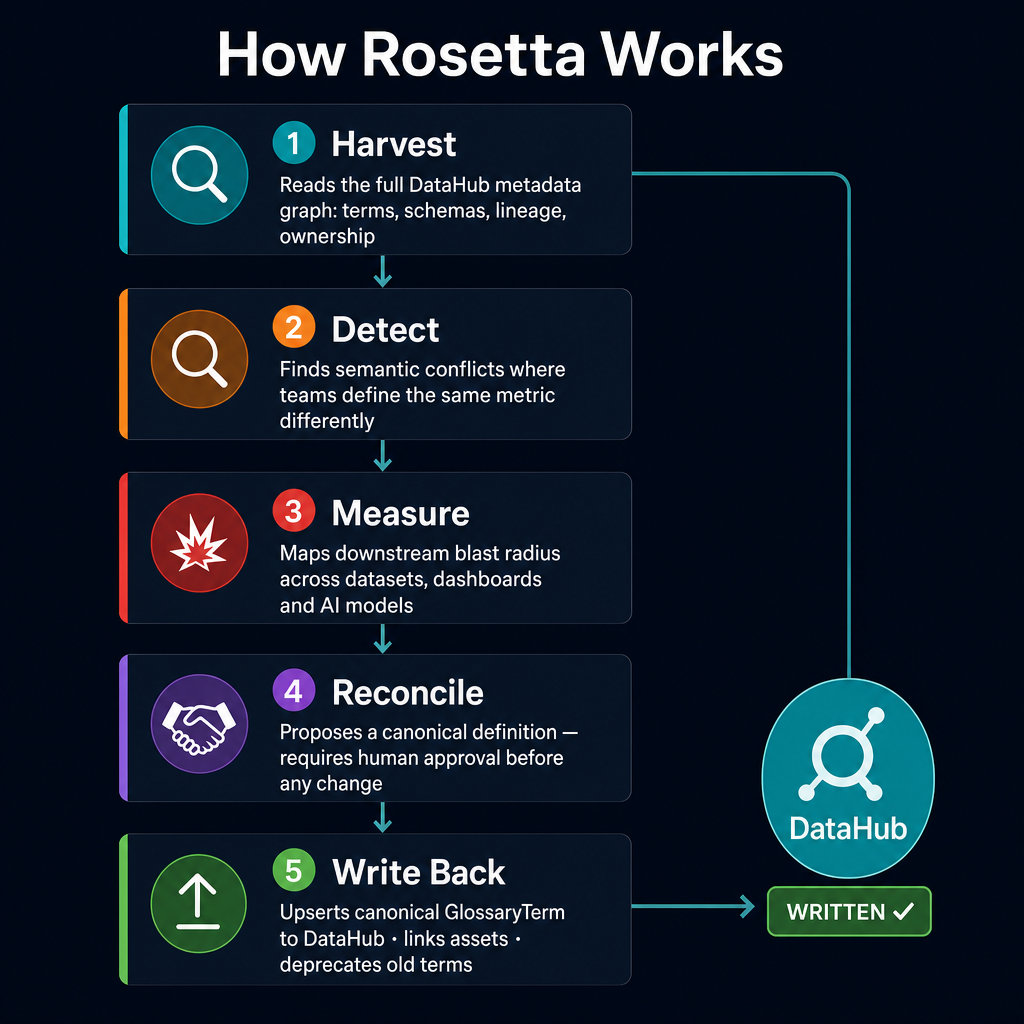
From raw metadata to a write-ready fix.

  1. Harvest metric definitions and lineage edges from DataHub
  2. Detect incompatible meanings across teams
  3. Trace blast radius — every downstream asset exposed
  4. Broker proposes a canonical GlossaryTerm definition
  5. Human approves → Rosetta generates a DataHub write plan
How Rosetta Works — five-agent pipeline
System Design

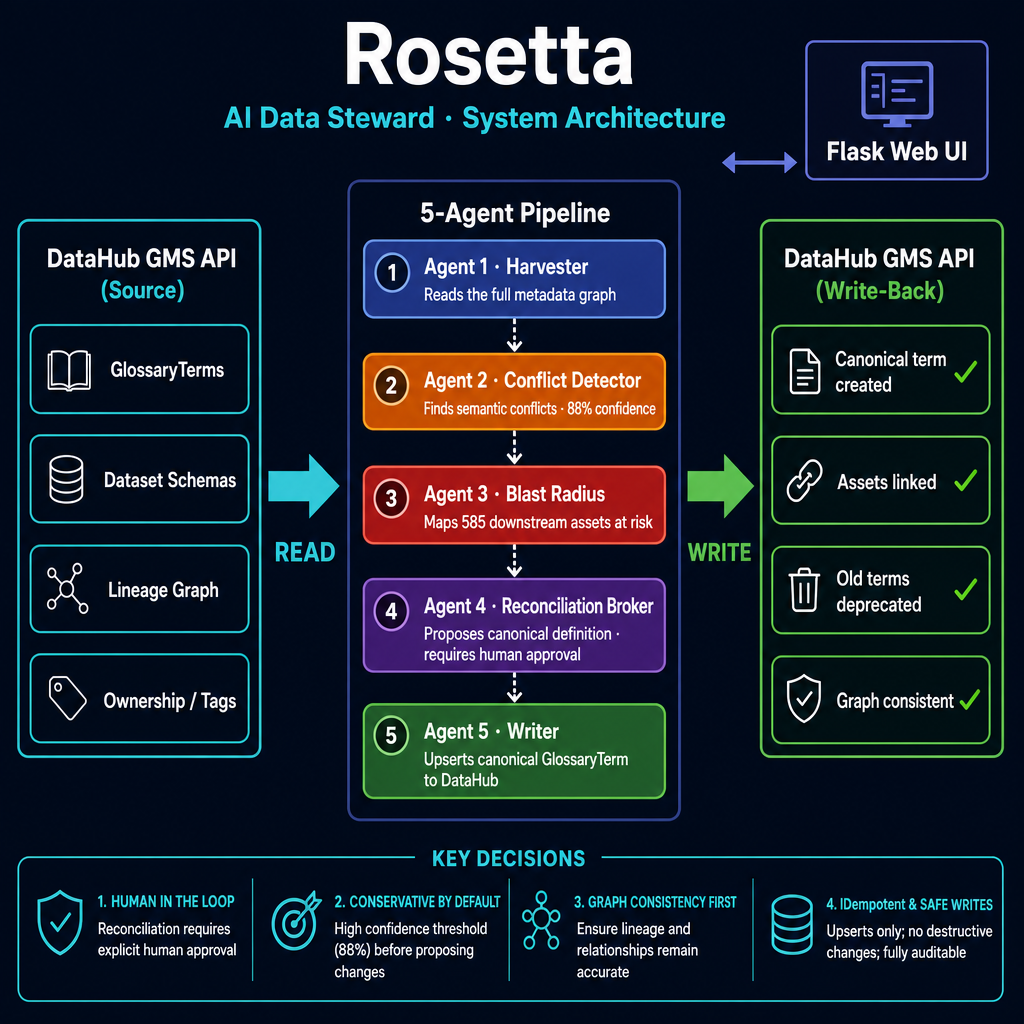
System Architecture

DataHub provides the metadata context Rosetta analyzes. Rosetta reasons over the graph and generates approved operations for applying the canonical fix in a connected DataHub environment.

Rosetta system architecture diagram
⟳ Harvesting DataHub graph…
⟳ Detecting semantic conflicts…
⟳ Analyzing blast radius…
⟳ Drafting reconciliation…
⟳ Generating validated DataHub write plan…